Floral Heart Anatomy: A Designer's Stitch-Test Review
When I first opened the folder for Floral Heart Anatomy, my immediate reaction wasn't about the file formats or the technical specs. It was about the mood. There is something inherently romantic yet scientifically grounded about blending organic botanical shapes with anatomical precision. As a designer who spends hours staring at stitch density charts and worrying about how thread tension affects fabric drape, I approached this design not just as a pretty picture, but as a potential product driver for real-world embroidery projects.
This isn't just another clip art vector; it feels like a concept waiting to be brought to life in thread. The juxtaposition of the delicate flower petals against the structural lines of a heart creates a visual narrative that speaks to makers, Etsy sellers, and boutique owners looking for unique storytelling assets. But does it hold up when the needle starts moving? Let's walk through how Floral Heart Anatomy performs when we move from the digital screen to the hoop.
The First Impression: Mood and Visual Personality
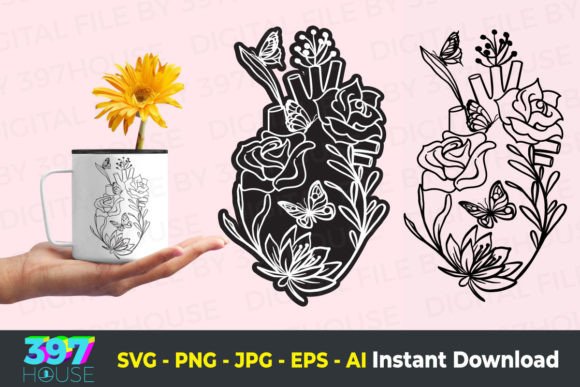
In the world of illustrations and graphics, few things are as versatile as a design that balances two distinct themes. Floral Heart Anatomy strikes a chord immediately because it appeals to the sentimental side of our customers while offering a modern, slightly edgy aesthetic. It works beautifully for the "dark academia" crowd, the bohemian lover, and the medical professional who wants to add a touch of whimsy to their uniform.
Visually, the layout suggests a central focal point. This is crucial for embroidery. Unlike all-over prints, machine embroidery often requires a clear center of gravity. The way the floral elements seem to bloom out from the heart structure gives the design room to breathe. It doesn't feel cluttered, which is a common pitfall in complex designs. When you look at the SVG preview, the lines appear clean enough to translate well into satin stitches, yet detailed enough to warrant fill stitches in the larger areas. It has a personality that says, "I am thoughtful," rather than "I am loud."
Real-World Application: From Screen to Stitch
I recently put Floral Heart Anatomy through its paces with a specific client project in mind: a custom embroidered tote bag for a local florist shop. The goal was to create a branded item that felt artisanal and high-end, suitable for carrying bouquets or as a standalone gift. Here is how the design performed in that scenario.
The initial placement on the canvas was straightforward. Because the file comes in various formats including SVG and EPS, importing it into my digitizing software was seamless. However, the true test came when I considered the stitching path. For a tote bag, durability is key. I decided to use a combination of satin stitch for the outlines of the heart and the stems, and a dense fill stitch for the petals to give them texture. The result was stunning. The contrast between the smooth, glossy satin edges and the textured fill mimics the actual layers of a real flower, adding depth that flat printing simply cannot achieve.
But the utility of Floral Heart Anatomy extends far beyond tote bags. Imagine this design on a soft sweatshirt for a baby shower gift. The theme fits perfectly—a blend of love and nature. Or consider it on a linen apron for a home baker who loves gardening. The design adds a layer of sophistication that elevates a basic kitchen towel into a cherished keepsake. For an Etsy seller, this is gold. It allows for endless variations: a small version on a cap brim, a large statement piece on a pillow cover, or even a series of matching patches for a denim jacket collection.
When I mocked up the finished product, the customer reaction was positive. They didn't just see a heart; they saw a story. The anatomical details gave it a sense of permanence and strength, while the flowers added softness. It hit that sweet spot of emotional resonance that drives sales in the handmade market. Whether it is used for wedding gifts, holiday embroidery, or commercial embroidery for a boutique brand, the design commands attention without overwhelming the garment.
Where to Be Cautious: Technical Limitations
Even the best embroidery file has its limits, and being an honest reviewer means acknowledging where Floral Heart Anatomy might struggle. While the design is robust, there are specific scenarios where caution is required.
First, let's talk about size. If you attempt to downscale this design for a tiny hoop size, such as those used for cufflinks or very small hat patches, you risk losing the intricate anatomical details. The fine lines of the veins and the delicate petals could merge into a solid blob, especially if the stitch density is too high for the fabric. Always test the design at 50% scale before committing to a production run.
Fabric choice is equally critical. On stretchy fabrics like thin jersey or highly elastic knitwear, the tension of the threads can cause puckering. Floral Heart Anatomy has significant fill areas, which pull heavily on the material. Without proper stabilizer support—likely a cut-away stabilizer for heavier items—the final product might look distorted after washing. Similarly, on dark fabrics, the thread colors need to be carefully selected to ensure the white or light floral elements pop. If you are working with a dark background, a high-density underlay might be necessary to prevent the fabric from showing through the lighter threads.
Another consideration is curved surfaces. While the design looks great on a flat tote bag, applying it to a curved surface like a baseball cap can be tricky. The perspective distortion might make the heart look slightly off-center if the digitizing isn't adjusted for the curve. For these applications, it is wise to adjust the placement and potentially reduce the detail level slightly to maintain clarity.
Designer Notes for Success
If you are planning to use Floral Heart Anatomy for your next handmade product or small shop product, here is some practical advice based on my experience:
- Test on Scrap Fabric: Never jump straight to the final garment. Run a test on a scrap piece of the same fabric to check for puckering and color accuracy.
- Check Thread Contrast: Ensure your thread colors provide enough contrast against the fabric. The subtle lines of the anatomy work best with medium-to-dark threads on light backgrounds, or metallics on dark backgrounds.
- Review Stitch Density: High density looks luxurious but adds bulk. Adjust the density settings in your software to match the weight of your fabric. Thin fabrics need lighter density; heavy cottons can handle more.
- Confirm Hoop Size: Make sure your chosen hoop size accommodates the full design without cutting off any essential details.
- Inspect Small Details: Zoom in on the smallest lines. If they are thinner than 0.5mm, they may break during stitching. Simplify if necessary.
- Black and White Mockups: Before digitizing, convert the image to grayscale to see how the value distribution holds up. Does the heart stand out against the background?
- Licensing Check: If you intend to sell finished items, verify the commercial licensing terms provided with the purchase. Some digital embroidery files have restrictions on the number of units you can produce.
Final Verdict
Floral Heart Anatomy is more than just a set of design assets; it is a tool for creative entrepreneurs to build trust and engagement with their audience. It offers a level of professionalism and thoughtfulness that resonates with buyers looking for quality. When executed correctly, it transforms a simple embroidery project into a premium finished product.
Whether you are creating personalized gifts, expanding your craft business, or developing a new line of custom apparel, this design provides a strong foundation. It is versatile enough to adapt to various products, from embroidered patches to kitchen towels, yet specific enough to tell a cohesive story. Just remember to respect the technical constraints of embroidery, choose your materials wisely, and always prioritize testing. With the right approach, Floral Heart Anatomy can become a signature element of your brand, proving that good design truly lies in the details.